
The Hidden Germ Geography of a London Office: Desks, Handles, and the Forgotten Keyboard Problem
Here’s an honest but not a particularly popular opinion: your London office is far dirtier than it looks, almost certainly dirtier than you’d care to think about over your morning coffee, and the worst offenders are not the ones you’d guess. It’s not the bathroom. It’s not the bin. It’s the surfaces you touch dozens of times a day without a second thought – the keyboard you’ve been typing on since Tuesday, the door handle you grabbed on the way in, the kettle in the break room that approximately forty people have touched since it was last properly wiped down.
London offices carry their own particular hygiene challenges. High footfall, open-plan layouts, shared facilities, and a workforce that commutes via one of the world’s busiest underground networks before settling in at a desk for eight hours. The microbial geography of a typical London workplace is, to put it scientifically, quite something. Let’s take a tour.
The Myth of the “Clean Enough” Office
There’s a comfortable assumption that many workplaces operate on, which goes roughly like this: if it looks tidy, it probably is tidy. Bins emptied, floors hoovered, surfaces wiped – job done. This is what hygiene professionals sometimes call “surface theatre”: cleaning that performs cleanliness rather than actually achieving it.
The reality, backed by a fairly sobering body of research, is rather different. Studies of shared workspaces consistently find bacterial counts on common office surfaces that would raise the eyebrows of anyone with even a passing interest in microbiology. The issue isn’t always the absence of cleaning – it’s cleaning that addresses the visible while leaving the genuinely problematic surfaces largely untouched.
London offices amplify this problem considerably. Open-plan environments mean more people sharing more surfaces. Flexible working arrangements and high staff turnover introduce more transient users with no particular attachment to the spaces they occupy. And the sheer density of daily activity – meetings, deliveries, visitors, contractors – keeps the bacterial refresh rate relentless.
Why Visual Cleanliness Is a Poor Proxy for Hygiene
A polished desk looks clean. Under laboratory conditions, that same desk can harbour thousands of colony-forming units per square centimetre – and that’s before lunch. Bacteria are entirely indifferent to aesthetics. A surface can be free of visible marks, crumbs, and spillages while still being thoroughly colonised by microorganisms that no amount of tidying will shift.
This is the central problem with visual-only cleaning standards: they measure the wrong thing. What matters isn’t whether a surface looks clean – it’s whether it’s been properly sanitised. These are two very different outcomes, and conflating them is where many office cleaning programmes quietly fall apart.
Desk Archaeology – What’s Actually Living on Your Workspace
Few pieces of workplace trivia land with quite the impact of this one: multiple studies have found that the average office desk carries significantly more bacteria per square inch than a toilet seat. This tends to produce one of two reactions – immediate disbelief, or an equally immediate desire to work from home permanently. Both are understandable.
The reasons are straightforward once you consider them. Toilet seats are cleaned regularly and used briefly for a single purpose. Desks, by contrast, are in near-continuous use, rarely deep-cleaned, and treated as personal territory where normal hygiene instincts somehow don’t apply. People eat at them, sneeze near them, place bags and phones on them, and spend the better part of eight hours in direct physical contact with them every working day.
The Lunchtime Contamination Cycle
Al-desko dining is effectively the national pastime of the London office worker. A sandwich from Pret, a pasta pot from the canteen, the occasional optimistic attempt at a salad – all consumed at the keyboard, often while simultaneously answering emails. The hygiene consequences are considerable.
Food debris provides the nutrients bacteria need to multiply. Moisture from drinks creates the conditions they prefer. And because desks are rarely sanitised between the morning clean and the following day, any contamination introduced at lunch has the entire afternoon and evening to establish itself. By the time the cleaning crew arrives the following morning, a thriving little ecosystem may already be well under way.
Personal Items and the “My Desk, My Rules” Problem
The desk surface is only part of the story. The items placed on it tell the rest. A mobile phone picked up and set down dozens of times daily, accumulating contact contamination with every surface it touches. A reusable coffee cup that’s been in a bag, on a Tube seat, and on three different surfaces before arriving at the office. A handbag placed directly on the desk after a journey on the Central line – which is, for what it’s worth, a long, warm, enclosed environment that functions with remarkable efficiency as a bacterial distribution network.
Personal ownership of a workspace, real or perceived, tends to reduce hygiene vigilance rather than increase it. The logic runs roughly: it’s my space, I know what’s there. Unfortunately, the bacteria occupying that space are not especially interested in that arrangement.
Handle With Care – The Touch-Point Trail Across Your Office
Beyond the desk, there’s an invisible journey that pathogens make across a typical office each day, hopping from surface to surface via the most mundane route imaginable: hands. Door handles, lift buttons, light switches, printer touchscreens, kettle handles, kitchen tap faucets – these are what hygiene specialists call fomites, or inanimate objects capable of transferring infection between people.
The problem with these surfaces isn’t that they’re particularly filthy in isolation. It’s the combination of high-volume contact and infrequent cleaning. A door handle touched by sixty people before lunch is a very different hygiene proposition from one touched by three. In a busy London office, the former is far more common than most facilities managers would comfortably assume.
The Kitchen and Break Room – A Microbial Social Club
If the desk is the office’s primary germ hotspot, the kitchen runs it a very close second. Shared sponges – which microbiologists have described as among the most bacteria-laden objects found in any indoor environment – the fridge door handle, the microwave keypad, and communal utensil drawers all present hygiene risks that routine cleaning tends to underserve.
The fridge deserves a specific mention. Cold does not mean sterile. A fridge shared by an entire floor of employees, where containers are moved, surfaces touched, and spillages addressed with varying degrees of enthusiasm, is a microbial environment that benefits enormously from regular, thorough attention rather than a fortnightly wipe of the visible shelves.
The Forgotten Keyboard Problem – Why IT Equipment Is in a Hygiene Blind Spot
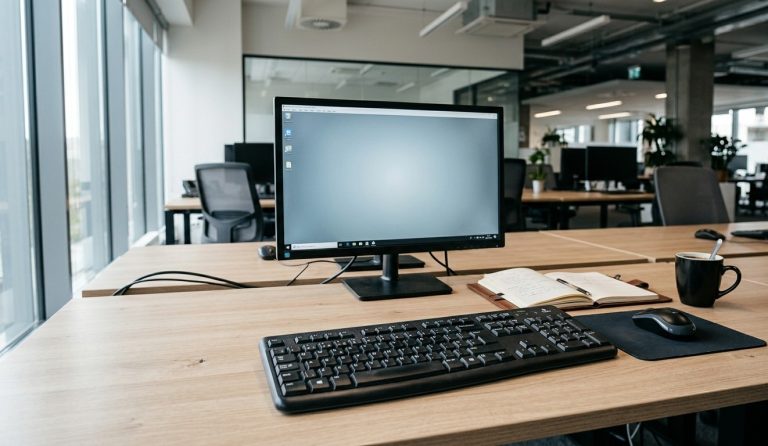
Here is where things get genuinely uncomfortable. Keyboards, computer mice, desk phones, and monitor bezels are among the most-touched surfaces in any office. They are also, consistently and across almost every workplace cleaning programme, among the least thoroughly cleaned. Some aren’t meaningfully cleaned at all.
The reasons are partly a technical reluctance – there’s an understandable hesitation around applying liquid near electronics – and partly a quiet jurisdictional grey area between facilities management and IT. Nobody is entirely sure who owns the keyboard problem, so it persists, accumulating bacteria between the keycaps with impressive efficiency.
Research into keyboard contamination has produced findings worth repeating. Studies have recovered pathogens including E. coli and Staphylococcus aureus from office keyboards. One study found keyboards harbouring bacterial levels sufficient to be classified as a health hazard. The detail that tends to resonate most: traces of food debris, skin cells, and biological matter found deep between the keys of machines that looked, on the surface, perfectly presentable.
Hot-Desking and the Keyboard Lottery
Hot-desking has become the defining feature of the post-pandemic London office. Flexible, efficient, and – from a hygiene standpoint – genuinely problematic. Every new user brings their own microbial profile to a keyboard that may not have been sanitised since it arrived in the building.
“Agile working” is a fine aspiration. A keyboard used by six different people in a single week, with no cleaning between users, is a less fine reality. In practical terms, hot-desking has transformed shared peripherals from a modest hygiene consideration into a pressing one.
How to Actually Clean Tech Without Destroying It
The good news is that cleaning keyboards, mice, and desk phones properly is neither complicated nor hazardous to the equipment – provided the right products and methods are used. Isopropyl alcohol wipes at 70% concentration are the industry standard for electronic surfaces: effective against a broad spectrum of bacteria and viruses, fast-drying, and safe for most plastic and rubber components.
Compressed air clears debris from between keys before sanitising begins. Screen-safe wipes handle monitor bezels and touchscreens. The single most important rule: nothing wet near ports or ventilation slots. Beyond that, the process is straightforward, and the difference in bacterial load between a properly sanitised keyboard and an untouched one is significant.
Building a Smarter Cleaning Strategy for London Offices
Understanding where contamination actually lives in an office – as opposed to where it is assumed to be – is the foundation of any genuinely effective cleaning programme. The distinction between maintenance cleaning and deep cleaning matters considerably here. Daily cleaning keeps a space presentable; a structured deep-clean programme with scheduled attention to touch-points, tech surfaces, and kitchen equipment is what actually manages bacterial load over time.
Touch-point schedules deserve particular attention in high-footfall environments. Identifying the most frequently contacted surfaces in a given office – which will vary by layout, headcount, and working patterns – and ensuring those surfaces receive targeted, regular sanitisation is a straightforward measure with a meaningful impact on overall hygiene.
What to Ask Your Office Cleaning Contractor
Not all commercial cleaning services are built the same way, and the difference between a genuinely thorough programme and surface theatre often comes down to specifics. It is worth establishing clearly whether touch-point cleaning is included in the standard scope, what products and methods are used on IT equipment, how kitchen appliances and communal surfaces are treated, and how frequently deep-cleaning is scheduled alongside routine maintenance visits.
These are reasonable, practical questions. The answers reveal quickly whether a cleaning programme has been designed around how an office is actually used – or simply around how it looks at the end of a shift.
London Office Germ Hotspots – Ranked by Bacterial Risk
- Shared keyboards and computer mice
- Desk surfaces (especially al-desko dining areas)
- Kitchen sponges and sink taps
- Fridge handles and microwave keypads
- Door handles and lift buttons
- Desk phones and printer touchscreens
- Light switches